What does IPTV mean?
IPTV stands for Internet Protocol Television. ITU-T describes IPTV as multimedia services delivered over managed IP-based networks that support specified service quality, security, interactivity, and reliability. Read the ITU-T definition of IPTV.
In this guide, “IPTV” refers to that television-service concept. The definition describes delivery over an IP-based network; it does not prescribe one app, device, or network design for every service.
How does IPTV work?
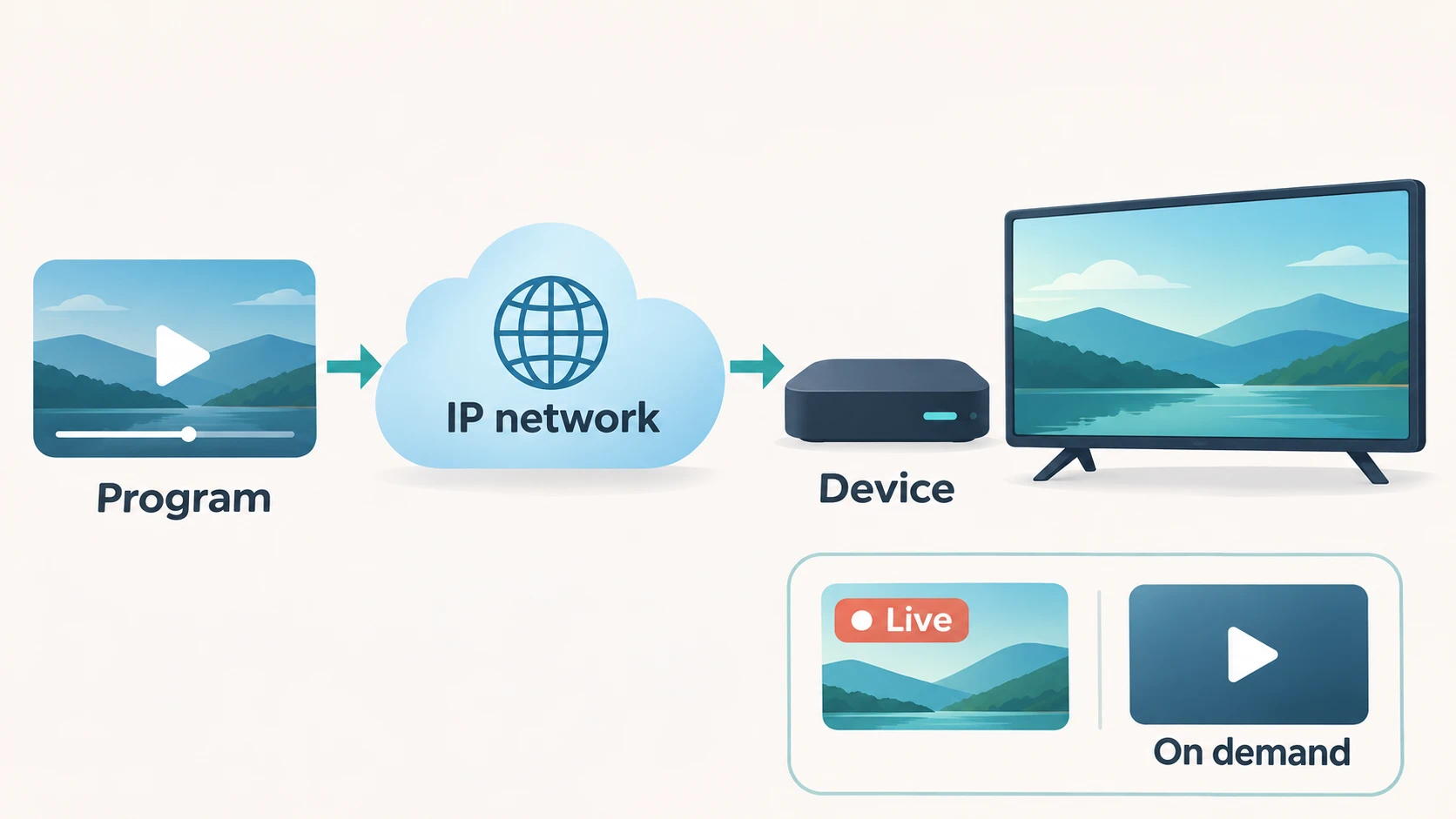
At a viewer level, the idea can be pictured as three steps:
- A service makes television programming or on-demand video available.
- An IP-based network carries the media data.
- A compatible app or device presents it for viewing.
This is a simplified explanation, not a claim that every service uses the same equipment or network architecture. ITU-T Recommendation Y.1910 is titled “IPTV functional architecture” and is listed as in force. Its public record page confirms the title and status; this article does not infer detailed architecture blocks from that page. Read ITU-T Y.1910.
What is the difference between live TV and on-demand video?
Live TV is watched according to a schedule or while an event is being streamed. On-demand video lets a viewer select content to play when they choose. A stream’s viewing format does not by itself identify the service’s full network design.
HTTP Live Streaming (HLS) is one streaming technology. Apple says HLS can deliver live and on-demand audio and video, uses ordinary web infrastructure, and adapts playback to network conditions. HLS is not another name for IPTV. Read Apple’s HTTP Live Streaming overview.
Is an IPTV app the same as a streaming protocol?
No. An app is software a viewer can use on a supported device. A streaming protocol such as HLS describes how media is delivered. IPTV, as used in the ITU-T definition above, refers to a television-related service delivered over managed IP-based networks. These are different parts of the viewing setup.
For examples of player apps and supported platforms listed by the site, see compatible applications and players. Check the service’s own current instructions for the required app and access method.
What may a viewer need?
Requirements depend on the particular service and device. Before setup, check its current guidance for:
- supported television, streaming device, phone, or computer;
- required app or access method;
- any required account or set-top equipment; and
- where to get help if playback does not work.
For device setup, see the site’s installation instructions. If a setup is already failing, use the troubleshooting guide.
Quick summary
- IPTV stands for Internet Protocol Television and, in the ITU-T definition, describes multimedia services over managed IP-based networks.
- A viewer-level delivery path is a simplification; service designs and device requirements can vary.
- Live and on-demand describe viewing formats. HLS is a separate streaming technology that supports both.
- Check the particular service’s current device and setup instructions.
Frequently asked questions
What does IPTV stand for?
IPTV stands for Internet Protocol Television.
Does IPTV use the internet?
The ITU-T definition describes IPTV services delivered over managed IP-based networks. The phrase “IP-based” alone does not specify that every service uses the public internet in the same way.
Is HLS the same as IPTV?
No. HLS is a streaming technology for delivering live and on-demand audio and video. IPTV describes a television-related service delivered over IP-based networks.
Do I need a set-top box to watch IPTV?
It depends on the service. Check its current support information for compatible devices, any required app or access method, and whether it specifies a set-top box.